
The Salon du Livre Jeunesse Afro-Caribéen returns to Paris this week with a programme asking what children see in stories, whose experiences become visible and how images shape the worlds they imagine.
The eleventh edition takes place in the former Tati Barbès premises. The organiser, D’un Livre à l’Autre, specifies that Friday 6 November is reserved for school groups; the general public programme begins on Saturday 7 November and continues on Sunday 8 November. This is an advance guide to the published plans, not a report from an event that has already happened.
For African and Caribbean heritage families, the programme offers a setting to encounter authors, illustrators and stories together. For people working in books, film and other visual media, its theme also raises a professional question: how can representation become a sustained creative practice rather than an occasional promotional claim?
### A new address and a weekend to plan
The Île-de-France regional authority’s event listing confirms the venue at 2 boulevard Marguerite-de-Rochechouart, Paris 18, close to Barbès-Rochechouart métro. It says more than 70 exhibitors are expected, from metropolitan France, overseas territories and abroad. That is an announced expectation, not an attendance total.
Sortiraparis’s guide, updated on 26 October, reports the move from Clichy and the free-entry registration requirement. Families should use the organiser’s address and current instructions: the guide’s map panel displays a different street number from the organiser and regional listing.
The Africultures calendar gives public opening hours of 10am–7pm on Saturday and 10am–6pm on Sunday. Times in this article are local to Paris. A visit should be planned around the activities suitable for a child’s age rather than assuming every session is designed for every visitor.
### Reading images, making stories
The programme’s theme, translated from French, is “The power of images — seeing ourselves, reading ourselves, dreaming ourselves”. The official schedule identifies Grace Ly as artistic director.
On Saturday, the official schedule includes an 11am discussion with Laura Nsafou, Balla Fofana and Khadim Sylla, moderated by Grace Ly, about images and stories in children’s development. Sortiraparis also highlights a 2pm meeting with Souleymane Mbodj, a manga workshop from age six and a 3pm stop-motion workshop from age five.
Sunday’s programme includes Jade Amory at 11am, Grace Ly at 2pm and storytelling with Halima Hamdane at 4pm, listed for ages four and above. These are scheduled appearances and activities; visitors should check the organiser’s page for changes.
The combination of reading and making is significant. Looking at an image and constructing one involve different kinds of attention. A creative workshop can give a child a way to ask who gets drawn, who takes the central role and what kinds of futures a story makes possible. That is an editorial reading of the programme’s potential, rather than a measured outcome claimed for the event.
### An opening for creators, with practical limits
The Bulles de Culture preview also highlights a professional space for writing projects, alongside the family programme. The organiser lists support from specialists including a literary agent, a writing coach and representatives of the children’s authors’ and illustrators’ organisation La Charte, with registration required.
Aspiring creators should treat that as an opportunity to prepare a focused conversation, not a promise of publication or representation. A short description of the intended audience, a clear account of the project’s stage and specific questions about the next step can make such a meeting more useful.
Admission is advertised as free on registration, but there is a practical point to resolve before setting out. During RIM’s checks, the HelloAsso ticket link on the programme page redirected to the association’s general profile rather than a completed event-booking screen. Readers should contact the organiser through its website if that continues; a redirected page should not be mistaken for a confirmed reservation.
RIM’s coverage of Black British Ballet’s library programme considers another way cultural organisations connect heritage and family participation. In Barbès, the coming weekend offers a related opportunity through books: meeting the people who make stories and taking part in the process of imagining them.
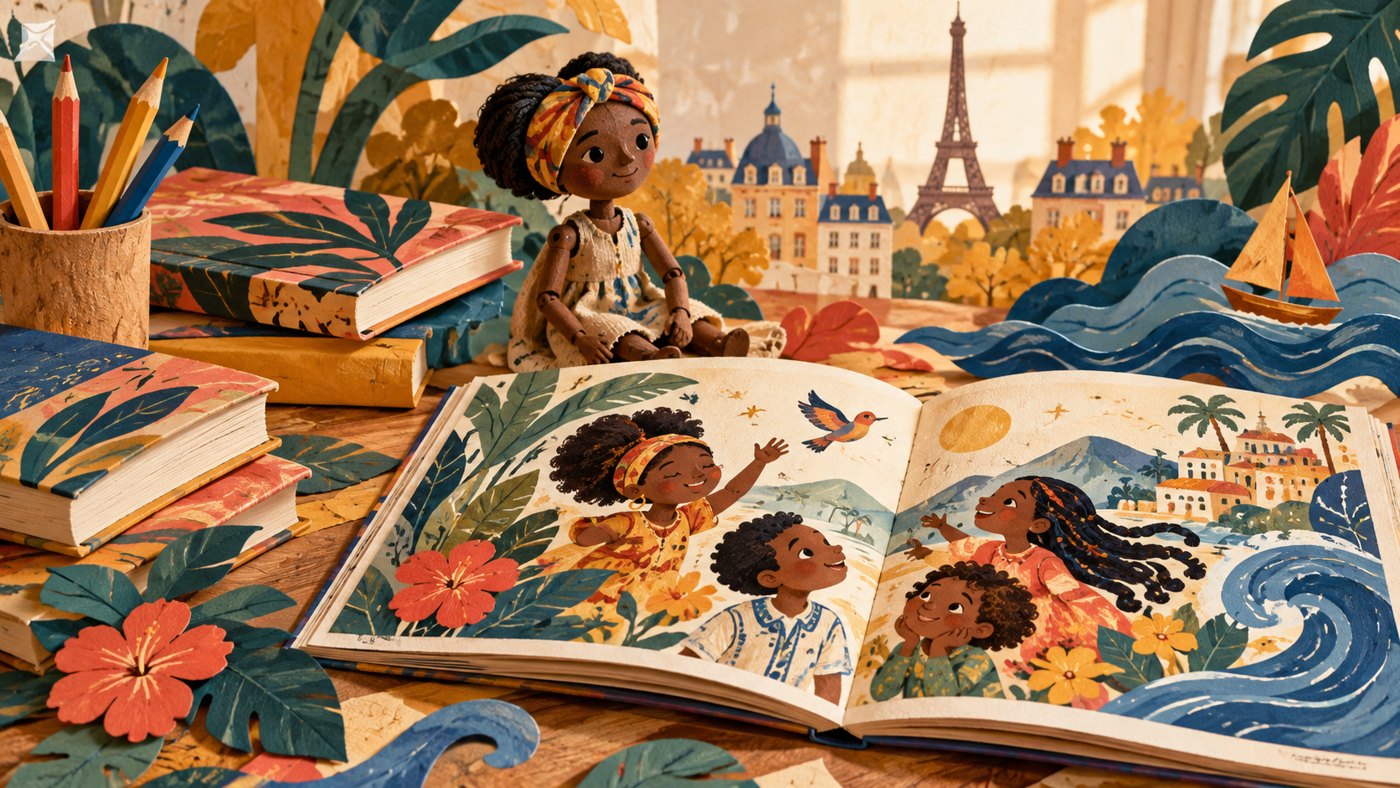
*Illustration: AI-generated books, drawing materials and fictional picture-book characters; no actual book cover, author or fair scene is depicted.*
Why this matters
Children’s publishing is one place where African and Caribbean heritage can be encountered in everyday family life. This fair brings creators and readers together while opening discussion about images, identity and imagination. It also gives emerging writers a potential route to practical professional guidance, without guaranteeing a publishing outcome. Clear information about the school-only day, the new address and the registration link matters because cultural access depends on families being able to plan a visit successfully.
Sources
- D’un Livre à l’Autre: official 2026 programme, venue and registration instructions
- Île-de-France: Afro-Caribbean children’s book fair event listing
- Sortiraparis: fair preview, updated 26 October 2026
- Africultures: dates and public opening hours
- Bulles de Culture: 2026 family and professional programme preview
- HelloAsso: association profile reached from the programme registration link during checks
Topics: France · Paris · African diaspora · Caribbean heritage · Children’s books · Representation · Creative careers
← All news & insights