
Nigerien engineer Mamane Kabirou Ousseini’s Africa Prize win offers a business story about what happens after equipment arrives. His venture, Likita Care, is built around the proposition that technology should be maintainable where its customers use it.
The £50,000 award was presented at the Royal Academy of Engineering’s final in Johannesburg on 28 October 2026. This analysis, published on 6 November, examines the commercial questions following that result; the award is not a new announcement today.
The Academy’s winner announcement identifies Ousseini as the first engineer from Niger both to participate in and win the competition. Its event record confirms the final’s date and Johannesburg venue. Disrupt Africa reported the result on 2 November.
Maintenance is part of the product
According to the Academy, Ousseini encountered imported monitoring equipment that fell out of use when spare parts and specialist support were difficult to obtain. Likita Care combines locally manufactured hardware with software, aiming to make medical monitoring equipment easier to support in Niger.
The immediate plan described in the winner announcement is to commercialise the venture nationally and prepare for neighbouring West African markets. That is an expansion ambition, rather than evidence of an already established regional network.
The distinction between selling a device and maintaining a service is central. RIM’s assessment is that a maintenance-led proposition must organise its people, supply arrangements and finances around the years after installation. A customer’s experience includes the time spent waiting for a replacement component and the clarity of the response when something fails.
This does not make local production automatically cheaper or more reliable. It makes the cost of keeping equipment working a necessary part of the comparison. Purchase price alone cannot answer that question.
Two ways of organising customer access
The Academy’s venture profile describes direct sales of complete kits, including installation, training and maintenance, alongside a subscription service with continuing technical support. It says production uses digital fabrication and electronics assembly in Niger, with essential components imported.
Those are descriptions of the proposed delivery model. The sources reviewed do not establish an audited comparison of the lifetime costs of the two options.
Commercially, the approaches create different obligations. A sale can bring revenue earlier, but a maintenance promise still needs resources after delivery. A subscription can spread a customer’s payments, while requiring the supplier to manage continuing costs before recovering its investment. Neither structure removes the need for dependable servicing.
For an expanding venture, a clear service agreement would help make those obligations assessable. Buyers would need to understand what support covers, how faults are escalated, what consumables or replacement parts cost, and what happens when the system is unavailable. These are questions for future commercial evidence, not claims that particular terms have been offered.
What the award establishes
The prize recognises an engineering venture and supplies development funding. The Academy says judging considered engineering strength, evidence of impact, commercial viability, scalability and the team. Its programme also provides training and mentoring.
The award should not be read as regulatory approval or independent proof of every performance claim. The Academy’s announcement and Disrupt Africa’s account describe the same underlying venture; their overlapping product claims do not amount to separate clinical evaluations.
The next useful business evidence would include sustained customer use, transparent servicing performance and a workable route to expansion. Regional growth would require the venture to demonstrate how support can remain responsive as customers become more dispersed.
For entrepreneurs in other sectors, the broader lesson is relevant without equating their products with medical equipment. Cameras, projectors and production systems also have working lives that extend beyond a purchase. RIM’s reporting on Eswatini’s proposed AI safety and standards centre similarly examines why technical capacity and testing matter alongside adoption.
Likita Care’s recognition gives Nigerien engineering a prominent platform. Whether that platform supports a durable business will depend on execution that remains visible after the prize ceremony.
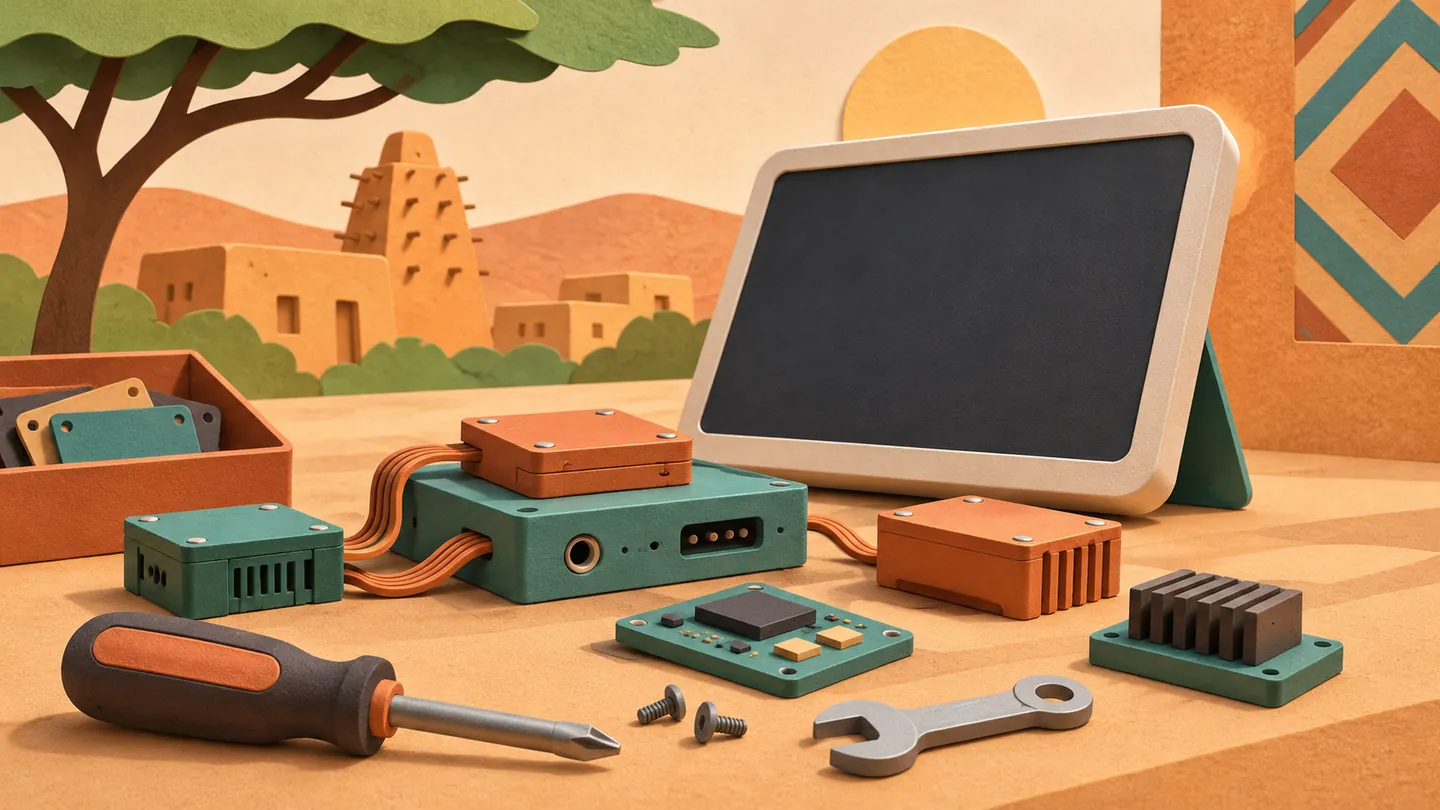
*Illustration: AI-generated artwork showing generic tools and modular electronics. It does not depict Likita Care’s actual devices or workshop.*
Why this matters
For African entrepreneurs, after-sales support can be a core source of value, especially where customers struggle to obtain parts or specialist help. Likita Care’s prize brings funding and visibility to a Nigerien venture built around that problem. Following the business beyond its award means examining service quality, customer costs and sustainable expansion, while keeping engineering recognition separate from regulatory approval and independently demonstrated clinical performance.
Sources
- Royal Academy of Engineering — Likita Care wins the 2026 Africa Prize for Engineering Innovation
- Royal Academy of Engineering — 28 October 2026 final, Johannesburg event record
- Disrupt Africa — Niger-based Likita Care wins Africa Prize, 2 November 2026
- Royal Academy of Engineering — Mamane Kabirou’s venture and delivery model
Topics: Niger · Likita Care · Engineering · Africa Prize · Local manufacturing · Entrepreneurship
← All news & insights