
Ghana’s cocoa season is entering a difficult period in which a higher official producer price and uncertain harvest volumes have to be considered together. Reporting this week describes farmers hoping for better yields by March 2027. The latest official weather guidance gives little basis for treating that recovery as assured.
In reporting published on 3 November, Reuters describes farmers facing a poor start after excessive rain in some areas and prolonged dry conditions in others disrupted flowering. The Ghana Cooperative Cocoa Farmers and Marketing Association told the agency that a March recovery would depend on suitable rainfall and a relatively mild harmattan. That is a conditional assessment, not an official harvest forecast.
The distinction matters for households making spending decisions now. A possible improvement several months away cannot be treated as income already earned. Nor can the experience of one farm, however serious its difficulties, establish the size of the national crop.
### The official outlook is regional
The Ghana Meteorological Agency’s November rainfall outlook expects generally normal-to-below-normal rainfall across most of the country, while parts of the Forest and Transition zones may receive normal-to-above-normal rain. The forecast therefore describes variation within Ghana, rather than one uniform national condition.
GMet’s technical advisory dated 30 October similarly cautions against treating El Niño as a complete explanation of local weather. It says impacts vary between events and regions, with conditions in the tropical Atlantic also influencing rainfall. The agency expects warmer-than-average temperatures in most locations, with regional differences.
These qualifications are central to useful reporting. A seasonal outlook can identify risks and guide preparation; it does not specify what will happen on every holding. Farmers’ observations and local weather information need to be read alongside the broader forecast. Calling an entire cocoa belt simply “too wet” or “too dry” would lose precisely the variation that the evidence identifies.
### Price support and production are different questions
The financial starting point comes from COCOBOD’s 25 September opening announcement for the 2026/27 season. It sets the producer price at GH¢42,400 per tonne, compared with GH¢41,392 in the previous season. The announced rate is GH¢2,650 per 64-kilogram bag, effective from 25 September.
The increase per tonne is approximately 2.4%, calculated from those published rates. Before any change in costs, a sufficiently large fall in the quantity sold can therefore outweigh that price improvement. This arithmetic does not estimate a particular farmer’s earnings. It explains why a better price and a difficult season can coexist.
COCOBOD’s announcement also commits to free fertiliser, hybrid seedlings and disease and pest control. These are stated interventions. Their presence in an opening-season statement does not independently establish when individual farmers receive support or what effect it has on yields.
### Preparedness has to reach the cocoa belt
Ghana News Agency’s 2 November account of GMet’s recommendations describes a coordinated role for ministries and technical agencies. For cocoa, it reports recommendations for joint monitoring with COCOBOD and targeted extension work, including shade management and disease control. More broadly, the recommendations cover water harvesting, irrigation and food and seed reserves.
RIM’s assessment is that the most useful follow-up will concern delivery: whether advice identifies affected districts, reaches growers in time and connects observations with practical support. National preparedness language becomes meaningful at that level. An advisory can improve planning, but publishing one is only the start of the process.
COCOBOD’s opening statement also links the sector’s future to greater domestic value addition. That ambition connects with our coverage of Ghana’s proposed bauxite-to-alumina processing chain. In cocoa, however, the immediate foundation for processing and trade is a dependable crop. Whether growers have the information and support to respond to changing conditions remains a practical test of that foundation.
As of 5 November, the evidence supports concern and preparation. It does not support a guaranteed March rebound, a precise new national crop total or a claim that conditions will be identical across cocoa-growing communities.
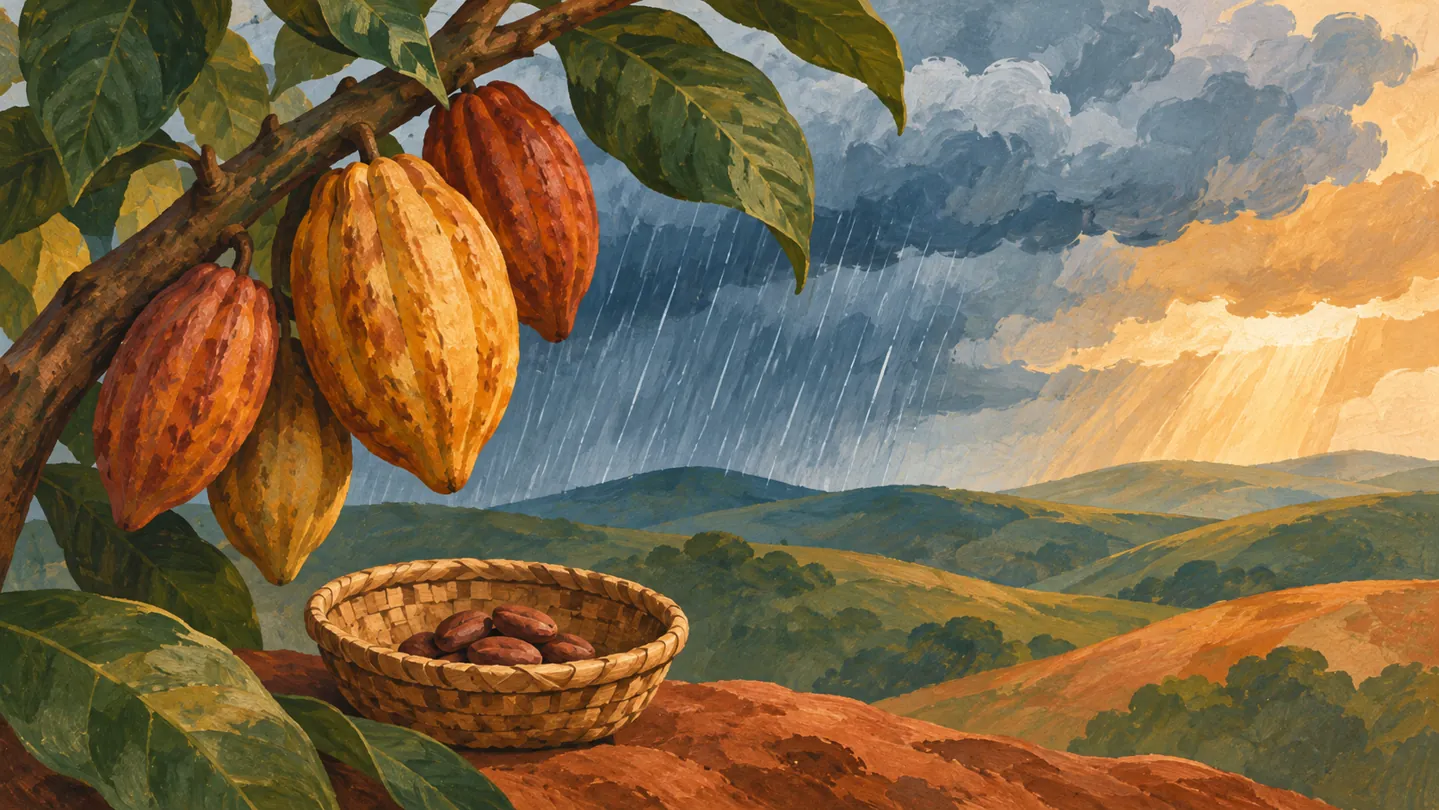
*Illustration: AI-generated conceptual artwork of cocoa pods and contrasting weather; it represents uncertainty and does not document a Ghanaian farm or this season’s crop.*
Why this matters
Cocoa growers have to plan household spending and farm work before the season’s final outcome is known. A modest increase in the announced producer price cannot by itself protect income if saleable volumes fall. For Ghanaian and diaspora readers, the reporting highlights the value of local forecasts, dependable extension services and clear evidence about delivery. Keeping hopes, weather probabilities and measured production separate makes the economic stakes easier to assess.
Sources
- Reuters: Ghana cocoa farmers hope for March recovery, 3 November 2026
- Ghana Meteorological Agency: November 2026 rainfall forecast
- Ghana Meteorological Agency: El Niño 2026–27 technical advisory, 30 October 2026
- COCOBOD: Producer price for the 2026/27 cocoa season, 25 September 2026
- Ghana News Agency: GMet calls for coordinated preparedness, 2 November 2026
Topics: Ghana · Cocoa · Agriculture · Climate · Farmer livelihoods · Economic development
← All news & insights