
Aliko Dangote launched a major fuel-storage and pipeline project at Walvis Bay on 4 November, putting Namibia at the centre of a proposed regional distribution network. The immediate significance is an investment announcement and launch, rather than an operating supply system: the infrastructure must still be delivered before businesses or households can judge its effect on fuel availability and costs.
Reuters reported from Walvis Bay that the industrialist announced investment of about US$2.5 billion and put the expected delivery period at 18–20 months. That is the developer's timetable, not an independently guaranteed completion date. The distinction matters for a project whose benefits depend on physical construction and connections across national borders.
### What has been announced
Namibian business publication The Brief's launch report describes a tank farm at Farm 58, roughly ten kilometres east of Walvis Bay. Planned storage totals 600 million litres, divided into 360 million litres of diesel and 240 million litres of petrol, with truck-loading and dispensing infrastructure.
Its account also describes a proposed pipeline of approximately 1,700 kilometres, connecting Walvis Bay through Otjiwarongo to Rundu, with an eastward connection towards Ghanzi and Francistown in Botswana. The developer envisages a wider market extending to Zambia, Zimbabwe, Malawi and the southern Democratic Republic of Congo. These are intended destinations and connections; they should not be read as completed supply agreements.
Crucially, The Brief reports that final pipeline alignment and length remain subject to detailed engineering, route surveys and regulatory approvals. A line on a presentation therefore cannot yet tell a community precisely where construction will occur, or a customer when deliveries will begin.
### A regional ambition needs a local delivery record
President Netumbo Nandi-Ndaitwah presented the investment as part of Namibia's ambition to become a regional energy hub. In a separate account of her remarks, The Brief reported her acknowledgement of bureaucratic delays and intervention to keep the investment moving.
Political sponsorship can help coordinate decisions, but it does not itself demonstrate that every technical or environmental requirement has been satisfied. Namibia's official environmental-project register contains a Farm 58 subdivision proposal identifying Dangote-related portions. That land application should not be mistaken for evidence that the whole tank farm and every section of the regional pipeline have final operating approval.
For readers following the project, the most useful next documents will concern its precise route, environmental conditions, financing and construction milestones. Each answers a different question. A land decision establishes where an activity may be considered; an engineering design describes what can be built; completed testing demonstrates whether it works. None is interchangeable with a launch ceremony.
### What businesses should watch
Additional storage could create more flexibility between the arrival of imported fuel and onward distribution. A pipeline, if completed and used effectively, could change the relationship between coastal supply and inland delivery. Those are plausible mechanisms, not evidence of an immediate fall in retail prices.
The commercial outcome will depend on matters the launch cannot settle: transport charges, throughput, maintenance, border arrangements and how savings or extra costs are passed along the chain. A large capacity figure alone does not establish that small operators will obtain cheaper fuel. Nor does it tell prospective suppliers which contracts will be available or on what terms.
For transport firms and other enterprises whose work depends on reliable deliveries, the practical test is the service ultimately provided. Businesses evaluating opportunities should distinguish a verified procurement notice from a general expression of investment ambition, and a signed delivery commitment from a projected market.
RIM's reporting on Wabtec and Transnet's locomotive-support agreement examines a related infrastructure question: the value of a network depends on sustaining its performance after the announcement. Namibia's new fuel proposal deserves the same attention to implementation. Its scale makes it consequential; the next stage is establishing how that scale becomes a dependable service.
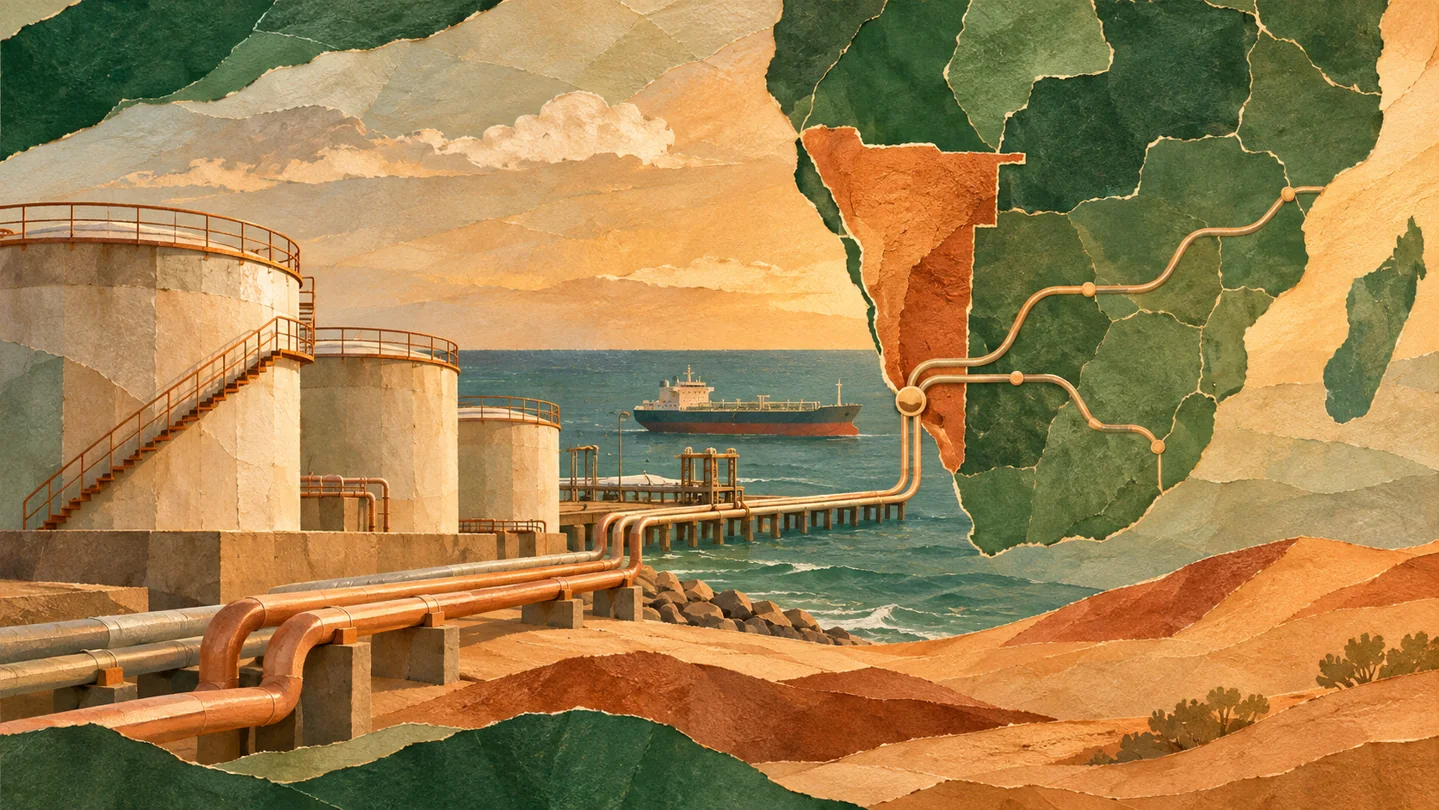
*Illustration: AI-generated generic fuel-storage and regional-network concept; this is not an actual facility or a verified pipeline route.*
Why this matters
Fuel logistics affects the operating conditions of businesses across southern Africa, including transport and production services. This proposal could become a significant new supply route, but treating planned capacity as an existing service would mislead readers and potential suppliers. Following approvals, construction and actual delivery terms will reveal whether the investment improves reliability and creates accessible business opportunities.
Sources
- Reuters: Dangote launches Namibia fuel-storage project, 4 November 2026
- The Brief: US$2.5bn fuel-storage and regional pipeline announcement, 4 November 2026
- The Brief: President's regional energy-hub remarks, 4 November 2026
- Namibian environmental register: Farm 58 subdivision proposal, project 7750
Topics: Namibia · Southern Africa · Dangote · Fuel logistics · Infrastructure · Regional trade
← All news & insights